From Listening to Living: Why Learning Music Is The Whole-Brain Workout for Life

Star Star

Introduction: From Enjoying Music to Experiencing It

There is hardly a person on Earth who doesn’t love music.

It’s the soundtrack of our lives – the gentle hum that accompanies us through work, study, love, and celebration. We listen when we are happy, when we are sad, when we need to think, or when we need to forget. Music has become so embedded in our daily lives that it’s easy to assume that simply listening is enough.

But here lies a quiet paradox.
While 100% of people are music listeners, less than 0.5% are active music learners. We consume music as a product, but few of us experience its creation – the profound act of making sound come alive with our own hands and minds.

Imagine if that changed.
What if, just as smartphones became indispensable tools of modern life, learning music became as normal and necessary as learning to read or use a computer? What if every home had not just speakers to play music, but instruments to create it?

Science, neuroscience, and human history agree on one truth:
Actively learning music doesn’t just make life more joyful — it makes the brain more powerful.

Neuroscientists at Harvard Medical School and the National Institutes of Health (NIH) describe active music learning as a “whole-brain workout.” Unlike any other single activity, playing an instrument lights up the brain’s auditory, visual, motor, memory, and emotional regions simultaneously.

“Music doesn’t just entertain us — it rewires us,” says Aubrey Aloysius, Founder & CEO of LorraineMusic.ai. “It makes us more human, more creative, more alive.”

At LorraineMusic.ai, our mission is simple but transformative: to make active music learning accessible, scientific, and joyful for every human being.
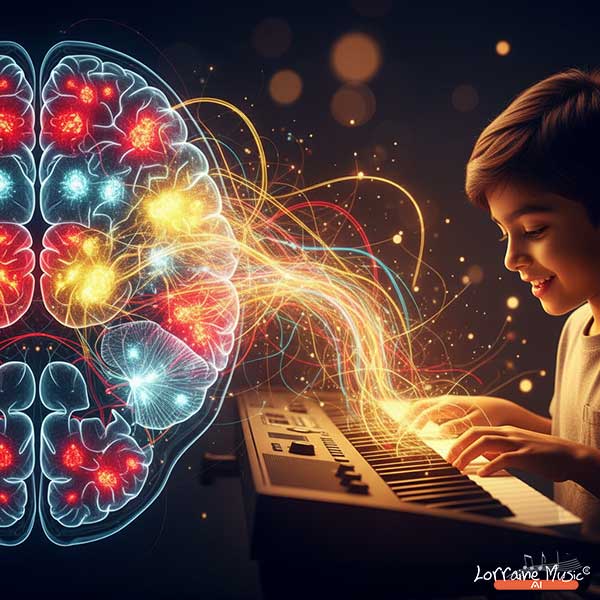
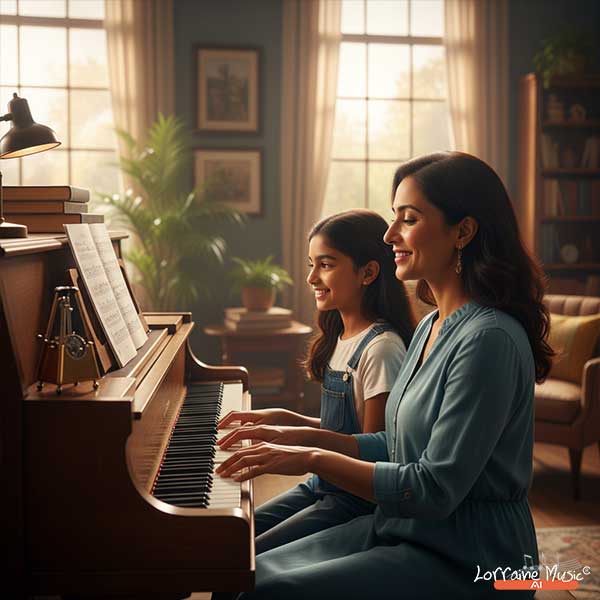
Music Activates Every Region of the Brain

1. Music Activates Every Region of the Brain

When you play an instrument or sing a melody, you aren’t just producing sound – you are performing one of the most complex acts known to the human brain.

The auditory cortex interprets pitch and rhythm. The motor cortex controls fine movement. The frontal lobe plans and organizes. The cerebellum coordinates timing and precision. And the limbic system translates sound into emotion.

MRI studies reveal that musicians develop larger and more interconnected neural networks than non-musicians. The connections between the analytical left hemisphere and the creative right hemisphere – the bridge of genius – grow stronger through musical practice.

This integration of hemispheres is what makes music unique. While sports, language, or mathematics may stimulate specific areas of the brain, music activates them all at once. It’s mental gymnastics and meditation combined – a harmony between logic and imagination.

“Playing an instrument is like a full-body workout for the brain,” notes Harvard neurologist Dr. Gottfried Schlaug.

2. From Memory to Mastery – Strengthening the Executive Brain

Every time a music learner reads a note, translates it into motion, and anticipates rhythm, the brain performs a symphony of cognitive functions. This constant exercise strengthens working memory, attention span, and executive skills like planning, sequencing, and decision-making.

Music learning also improves auditory memory – the ability to hold and process sound patterns. Students who engage in structured music education demonstrate superior results in academic performance, linguistic development, and mathematical reasoning.

For adults, learning music rejuvenates cognitive agility and promotes lifelong learning. AARP research shows that adults who take up music later in life exhibit improved mental flexibility, faster problem-solving, and sharper focus.

Think of it as mental cross-training – every measure you play is a workout for your attention, discipline, and creativity. And unlike rote memorization, music involves both repetition and emotional connection, which deeply embeds learning in long-term memory.

From Memory to Mastery - Strengthening the Executive Brain
Indian pianist and tabla player performing together, highlighting musical coordination and expressive motion.

3. The Symphony of Movement – Music Improves Coordination

Playing an instrument is a complex motor task requiring split-second timing.

When both hands move independently – as in piano – and eyes and ears synchronize with rhythmic cues, the corpus callosum (the fiber bridge between hemispheres) thickens, improving coordination.

Children who learn instruments display improved handwriting, athletic performance, and fine motor skills. Adults develop better posture, balance, and reaction time. For individuals recovering from neurological disorders, music therapy has shown remarkable benefits in reactivating motor control.

It is also a dance of mind and body – one where discipline and delight merge seamlessly.

The rhythm teaches timing; melody teaches anticipation; harmony teaches awareness. In short, music teaches the body to think.

4. Music and the Emotional Brain – Building Empathy and Expression

Music doesn’t just make us think – it makes us feel.

When you play or sing, the limbic system and amygdala (centers of emotion and empathy) come alive. This is why music therapy has been proven to alleviate depression, anxiety, and trauma.

Learning music cultivates emotional intelligence (EQ) – the ability to understand, express, and manage feelings. Children who learn to perform develop greater confidence and empathy, while adults rediscover emotional release and mental balance.

Group learning amplifies this effect. When students play together, their breathing, heart rate, and brainwaves begin to synchronize – creating literal harmony among people.

“Music touches the emotional centers of the brain in a way nothing else can,” says Dr. Lisa Wong, musician and Harvard physician.

At LorraineMusic.ai, we have seen countless students – from toddlers to senior citizens – experience emotional transformation through consistent musical practice.

Indian children’s ensemble performing joyfully with an expressive lead singer under warm stage lighting, symbolizing emotional connection through music
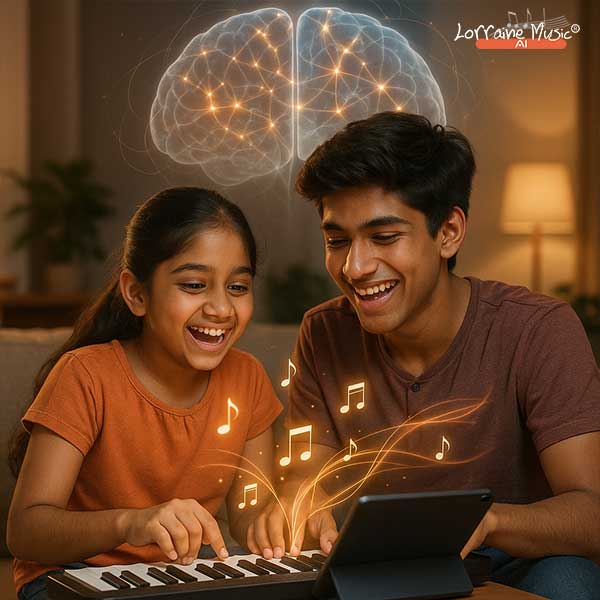
Two Indian music learners, a young girl and teenage boy, composing joyfully on a tablet with glowing notes and a neural network symbolizing creativity and brain connectivity.

5. Music Builds Stronger Brain Connectivity and Creativity

Neuroscience confirms that consistent music practice strengthens white matter pathways, particularly those linking the auditory, visual, and motor systems.

This enhanced connectivity accelerates information processing, pattern recognition, and abstract reasoning – skills vital in science, design, and innovation.

But beyond logic, music fuels creative thinking.

Improvisation exercises – making up melodies spontaneously – stimulate the prefrontal cortex in ways that mirror the neurological state of flow, where creativity thrives.

Aubrey Aloysius explains: “Learning music is like learning how to think in 3D – it teaches the brain to move effortlessly between logic, intuition, and emotion, and creatively transforming the process into a single harmonious act – the true foundation of genius.”

This blend of structure and spontaneity makes music education one of the best investments in personal growth and intellectual capacity.

6. Preventive Brain Health – Music as Mental Fitness

If gym workouts sculpt the body, music sculpts the brain.

A 2021 NIH study revealed that older adults who continued musical engagement had younger-looking brains, higher memory retention, and lower risk of cognitive decline.

Music triggers the release of dopamine (motivation) and serotonin (happiness), improving mood and reducing stress hormones. Regular practice improves sleep quality and reduces symptoms of depression and anxiety.

Even brief daily sessions – 15-30 minutes of active practice – can measurably enhance neuroplasticity.

This is why music therapy is increasingly used in hospitals, rehabilitation centers, and senior wellness programs.

At LorraineMusic.ai, our AI-based adaptive platform allows learners to practice at their own pace – ensuring that consistency, not perfection, drives progress and well-being.

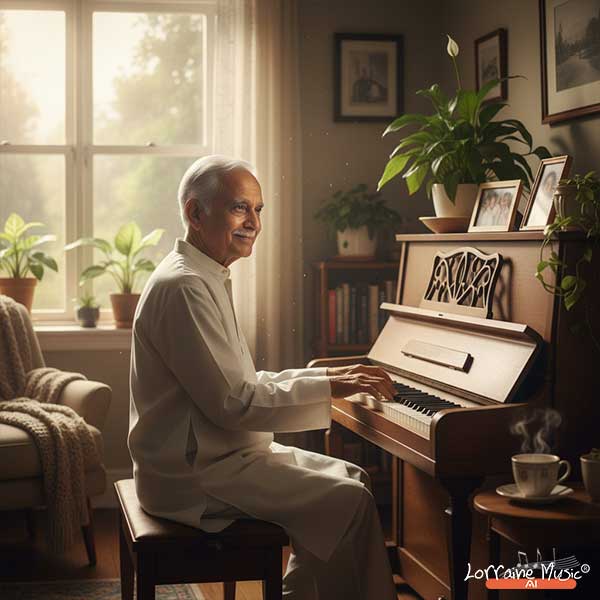
Elderly Indian person playing piano in soft sunlight surrounded by plants, symbolizing lifelong mental fitness and music as a ritual of wellness.
Indian family and friends enjoying music together with keyboards and guitars, symbolizing bonding and active participation through shared learning

7. From Listeners to Learners — The Joy of Participation

Music is not meant to be observed; it’s meant to be lived.

Yet, today, the majority of the world consumes music passively – through headphones and algorithms – rather than producing it through their own expression.

We live in an era where almost everyone listens to music – but less than 1% actively learns it.

Just imagine what would happen if we flipped that number.

The gap between listening and learning is not one of talent, but of mindset. People believe they must be “gifted” to play an instrument, when in reality, anyone can learn with the right guidance and tools.

LorraineMusic.ai is changing that narrative. With structured AI-guided modules, even complete beginners can start playing melodies within minutes. Families can learn together; professionals can unwind through evening practice; seniors can rediscover joy and mental sharpness through music.

Imagine a society where homes resonate not just with playlists, but with live music made by those who love it.

That is the world we are building – one note at a time.

8. Why Music Education Matters in the AI Age

We live in an era where machines can compose songs and algorithms can predict our emotions. But no AI can feel a melody or empathize through sound the way humans do.

Music education develops precisely those human abilities that technology cannot replicate: creativity, empathy, discipline, and collaboration.

At LorraineMusic.ai, we embrace AI not as a replacement for teachers, but as an amplifier of human potential.

Our platform personalizes every learner’s journey – adapting tempo, feedback, and progression using intelligent analytics. It’s like having a patient, encouraging mentor available 24×7.

“At LorraineMusic.ai, we use AI not to replace teachers, but to augment and amplify human potential,” says Aubrey Aloysius. “We want everyone – from children to professionals – to experience what happens when the brain and heart play in harmony. We want technology to bring humanity back into learning. Our AI listens, guides, and celebrates your progress – helping you experience the joy of learning music without fear or frustration.”

In a future driven by automation, the ability to create – to express emotion through music – will remain one of the most valuable human skills.

Indian student learning piano with a 5-octave keyboard and AI guidance on a tablet, representing personalized and intelligent music education through LorraineMusic.ai
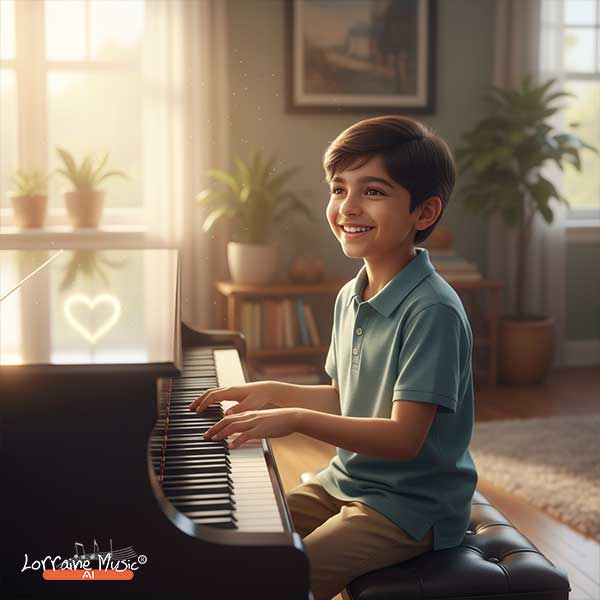
Indian child smiling after finishing a piano piece, with a heart-shaped reflection on the piano lid symbolizing harmony between science and soul in music.

9. The Science and the Soul – Music as Life’s Best Investment

Music uniquely unites science and soul.

It engages neural precision while awakening emotional depth. It demands structure yet rewards creativity.

It’s a discipline that enhances all other disciplines – mathematics, languages, leadership, and empathy.

Learning music improves confidence, patience, and self-esteem. Every small victory – every note played right – reinforces perseverance. This is why children who study music often perform better academically and socially.

For professionals, music offers a reset – a mindful escape that renews focus and balance.

For elders, it preserves identity and connection.

For everyone, it nurtures a lifelong relationship with beauty and discipline.

Train Your Brain, Transform Your Life

Music learning is not a luxury – it’s a human necessity.

Just as literacy transformed civilization and smartphones revolutionized communication, music literacy will transform human creativity and well-being.

Every note you play strengthens your brain. Every rhythm you master enhances your focus. Every melody you create heals your emotions.

At LorraineMusic.ai, we have made the journey simple, scientific, and joyful. Whether you are 4 or 84, our adaptive AI system meets you where you are – guiding you step by step to become a confident music maker.

Stop listening about music. Start living it.
Your instrument is waiting. Your mind is ready.