Why Music Literacy Matters in Today’s World

Just as the ability to read and write transformed societies during the Information Age, the ability to read, write, understand, and create music is emerging as a defining skill in the Creative Economy. Music literacy is not about becoming a professional musician—it is about becoming fluent in the language of music, a skill that strengthens cognition, enhances creativity, and drives measurable economic value.

In India, where the National Education Policy (NEP 2020) calls for arts-integrated holistic learning, and where the National Skills Qualification Framework (NSQF) is validating employable skills, music literacy stands at the intersection of culture, skills, and economic growth.

What is Music Literacy?

Music literacy goes beyond playing an instrument or singing. It is the ability to fluently read, write, and communicate musical ideas, just as language literacy enables us to express thoughts and stories.

Core Components of Music Literacy:

  1. Reading & Writing Notation – Understanding staff notation, rhythm, scales, harmony, dynamics, and musical symbols.
  2. Listening & Comprehension – Recognizing pitch, rhythm, harmony, timbre, and diverse form when hearing music.
  3. Performance Skills – Applying knowledge on instruments, voice, or digital tools to express musical ideas as a form of personal and cultural expression.
  4. Creation & Improvisation – Composing, arranging, or improvising music.
  5. Critical Appreciation – Analyzing music across genres, cultures, and history, much like literary appreciation in language.
  6. Digital Music Literacy – In today’s world, also includes using music technology: Using DAWs (Digital Audio Workstations), AI-powered composition tools, and online collaboration platforms.

In short: Music literacy is fluency in the universal language of music.
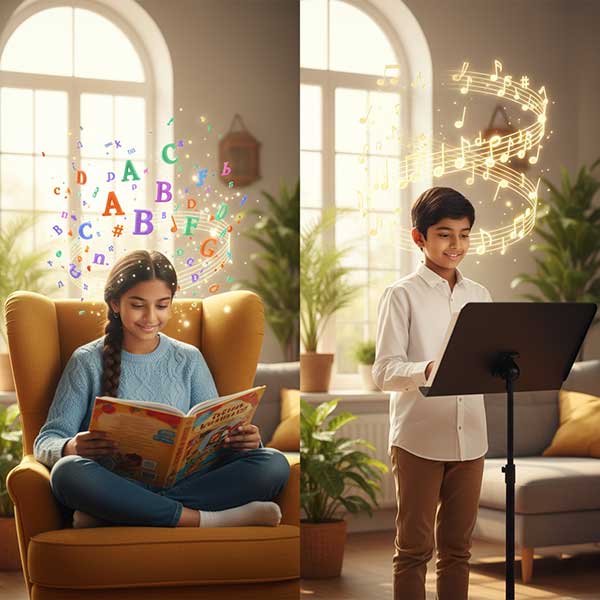
Language Literacy vs Music Literacy

The Economic Benefits of Music Literacy

Music literacy is not just cultural enrichment – it is an economic multiplier. It drives tangible economic value at personal, community, and national levels. Like English literacy once powered the IT and outsourcing boom, music literacy can power the creative economy, now valued globally at $2.4 trillion.

  1. Employability & Careers
    • Trained & Certified musicians, educators, composers, therapists, and technologists are in high demand worldwide.
    • NSQF-aligned certifications (like what we are building at LorraineMusic.ai) validate skills, making music literacy a job oriented and job-ready skill.
    • Example careers: A musically literate person can earn by teaching, performance, composing for media (film/ads/gaming), content creation, or freelancing in creative industries.
  2. Driving the Creative Economy
    • The global creative economy is valued at $2.4 trillion and expanding rapidly. Music is a central pillar. Music literacy fuels film, gaming, advertising, and wellness industries.
    • Music literacy feeds into industries like film, advertising, gaming, wellness, and Music EdTech.
    • In India, scaling music literacy aligns with NEP-2020 and creates a skilled workforce for domestic and global markets.
  3. Cognitive Productivity & Innovation
    • Studies show music literacy improves memory, problem-solving, and focus – leading to higher performance across professions.
    • Corporates investing in music literacy report better collaboration and productivity – an indirect but significant economic gain.
  4. Health & Wellness Industry
    1. Music therapy (backed by music literacy) is a billion-dollar global sector addressing stress, dementia, rehabilitation, and mental health.
    2. Literate musicians trained in therapy can open sustainable income streams while reducing healthcare costs.
  5. Cultural Exports & Soft Power
    • Nations with high music literacy (e.g., Western Europe, South Korea with K-pop) turn cultural capital into global economic powerhouses.
    • For India, music literacy can transform its rich traditions and boost cultural exports, tourism, and global influence – directly impacting GDP.
  6. Inclusive Participation
    • Music literacy is a low-barrier skill — teachable across age, background, and geography.
    • This enables micro-entrepreneurship: local tutors, performers, and creators earning in their communities while contributing to national economic activity.

In essence: Music literacy is to the creative economy what English literacy was to the information economy.

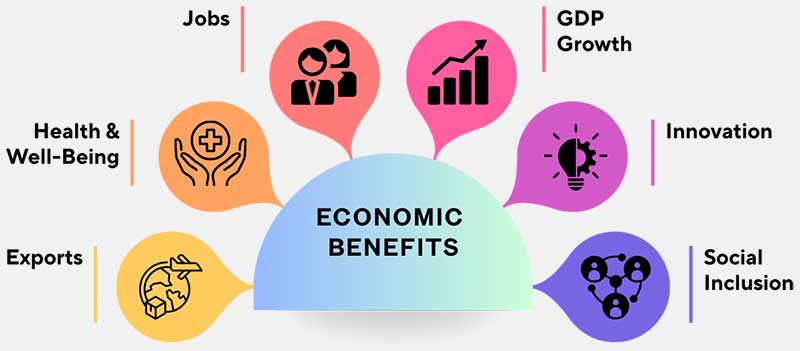
Economic Benefits

Music literacy is a thinking skill that also leads to jobs and wellness. It improves concentration, memory, and teamwork, which benefits all careers.

How Music Literacy Augments Success Across Professions

Music literacy develops cognitive, emotional, and social capacities that directly enhance performance, employability, and income-generation across sectors. Below are specific transferable benefits to career archetypes:

Professionals (Doctors, Lawyers, Engineers)

  • Focus & Precision: Music training strengthens attention to detail – useful in medicine, law, engineering.
  • Analytical Skills: Reading notation develops pattern recognition, akin to interpreting complex data or cases.
  • Outcome: Professionals become sharper, more creative problem-solvers, commanding higher fees and recognition.

Businessmen / Entrepreneurs

  • Creativity & Innovation: Composing and improvising in music mirrors innovation in business models.
  • Risk-Taking & Resilience: Performance teaches handling stage pressure → resilience in markets.
  • Team Leadership: Conducting/ensemble playing = managing teams.
  • Outcome: Music-literate entrepreneurs think laterally, innovate faster, and manage uncertainty better.

Self-Employed / Freelancers

  • Self-Discipline: Daily practice instills consistency – vital for freelancers and independent professionals.
  • Client Engagement: Musical empathy enhances interpersonal skills and networking.
  • Outcome: More stable income through stronger reputation and repeat clients.

Farmers

  • Cognitive Agility: Music literacy builds attention and memory → helps manage farm cycles, accounts.
  • Community Building: Farmers with music skills can organize cultural events, adding supplementary income from local performances.
  • Outcome: Music literacy diversifies rural income and strengthens community bonds.

Scientists

  • Pattern Recognition: Music strengthens abstract reasoning, useful in research and data analysis.
  • Persistence: Musical mastery requires trial/error – mirrors the scientific process.
  • Outcome: Scientists innovate with sharper creative and analytical thinking.

IT Professionals

  • Coding Parallels: Music notation ≈ programming languages (syntax, logic, flow).
  • Focus & Flow: Practicing music develops deep work and flow states – improving coding productivity.
  • Outcome: Faster debugging, better algorithms, career growth in high-paying IT roles.

Geologist

  • Pattern Detection: Musical ear helps recognize geological patterns and anomalies.
  • Patience & Attention: Long hours in field analysis mirror the persistence learned from music.
  • Outcome: More accurate research, career advancement, and consultancy opportunities.

Consultants

  • Listening Skills: Music literacy trains active listening → consultants diagnose client needs better.
  • Presentation Skills: Stage performance translates to persuasive client presentations.
  • Outcome: Stronger client trust, repeat projects, higher fees.

Sports Persons

  • Rhythm & Coordination: Timing in music improves motor coordination, reflexes, and stamina.
  • Resilience: Performing under audience pressure = coping with stadium pressure.
  • Outcome: Enhanced athletic performance and mental focus → higher earnings & sponsorships.

Spiritual Leaders / Religious Persons

  • Emotional Connection: Music deepens spiritual expression and worship.
  • Community Leadership: Hymns, bhajans, chants build large followings.
  • Outcome: Greater influence and sustainable income through cultural engagement.

Social Workers

  • Empathy: Music fosters compassion and emotional intelligence – critical in social interventions.
  • Community Mobilization: Group singing/events unite communities around causes.
  • Outcome: Social workers become more effective, building credibility and donor confidence.

Politicians

  • Oratory & Rhythm: Music enhances voice modulation, timing, and persuasive delivery.
  • Cultural Connect: Politicians leveraging music connect deeper with masses.
  • Outcome: Stronger public appeal, influence, and electoral success.

Public Servants / Bureaucrats

  • Analytical Rigor: Music reading enhances attention to structure, aiding in policy drafting.
  • Stress Management: Playing music balances mental health amidst bureaucratic pressures.
  • Outcome: Higher efficiency, reputation for balanced decision-making.

Blue Collar Workers

  • Skill Training Discipline: Music instills consistency and precision – Precision and discipline transferable to manual tasks.
  • Community Engagement: Supplementary income via local teaching or performances.
  • Outcome: Economic resilience and social upliftment. transfer to skilled labor.

Land Bankers / Investors

  • Long-Term Thinking: Music teaches patience – valuable in land banking and wealth creation.
  • Pattern Foresight: Identifying music structures helps investors spot market trends.
  • Outcome: Smarter investment timing and stronger negotiation presence.

Academicians

  • Research & Writing: Music literacy sharpens abstraction, improving theory-building and academic writing.
  • Teaching Engagement: Using music in pedagogy makes concepts memorable.
  • Outcome: Higher citations, recognition, and research grants.

Bureaucrats

  • Balance & Diplomacy: Ensemble playing teaches negotiation and compromise.
  • Cultural Diplomacy: Music enhances India’s soft power globally.
  • Outcome: Bureaucrats become better negotiators and cultural ambassadors.
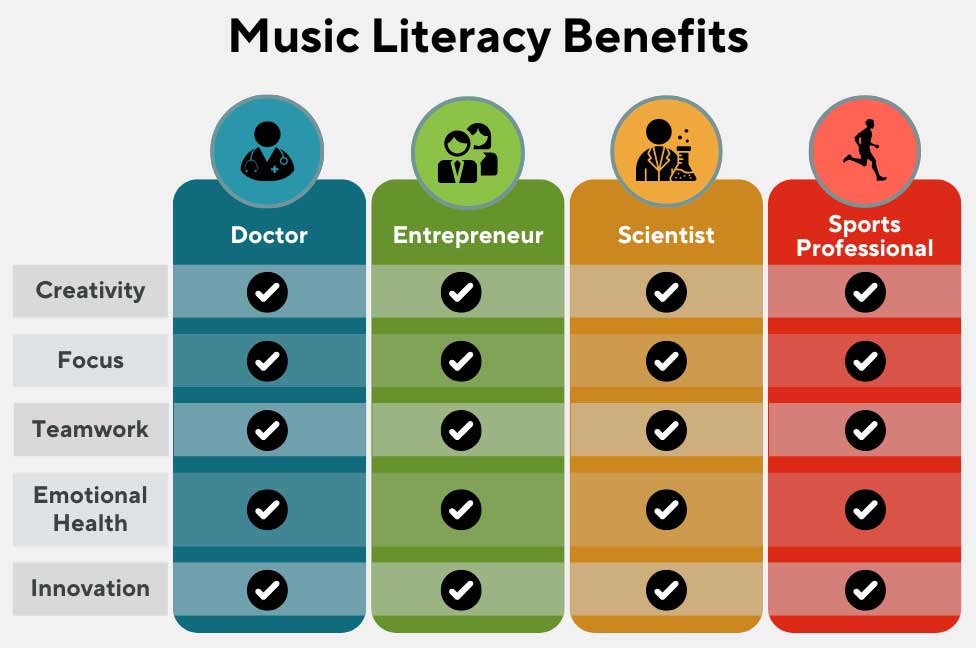
Music Literacy Benefits

The Universal Multiplier

No matter the profession, music literacy enhances:

  1. Cognition → sharper memory, creativity, analysis.
  2. Communication → better listening, expression, persuasion.
  3. Collaboration → stronger teamwork and leadership.
  4. Resilience → stress management and persistence.
  5. Innovation → improvisation and lateral thinking.

Result: Higher productivity, stronger reputation, and better income potential.

GEO Context: Why India Should Lead the Music Literacy Movement

  • India’s advantage: NEP-2020, 1.5 million schools, young demographic.
  • Economic Upside: ~₹1.7 lakh crore projected 5-year impact (2026–2030).
  • Global Opportunity: Export India’s music culture as soft power like Yoga & Ayurveda.

FAQs on Music Literacy

No. It’s a thinking skill that benefits doctors, scientists, entrepreneurs, and workers alike.

2–3 hours of structured learning weekly delivers results.

Blended online/offline models + community tutors keep costs low.

Yes. Our certifications validate skills for education, EdTech, wellness, and creative industries.

Music literacy is not a luxury – it is a 21st century skill for jobs, wellness, and national prosperity.

Parents

Encourage your children to learn music literacy.

Schools Schools

Schools

Adopt our certified music programs.

Corporates Corporates

Corporates

Fund music literacy as HR wellness & CSR.

Your Dream. Your Pace. Your Piano.

Music literacy is India’s chance to lead the world into a creative, innovative, and inclusive future.

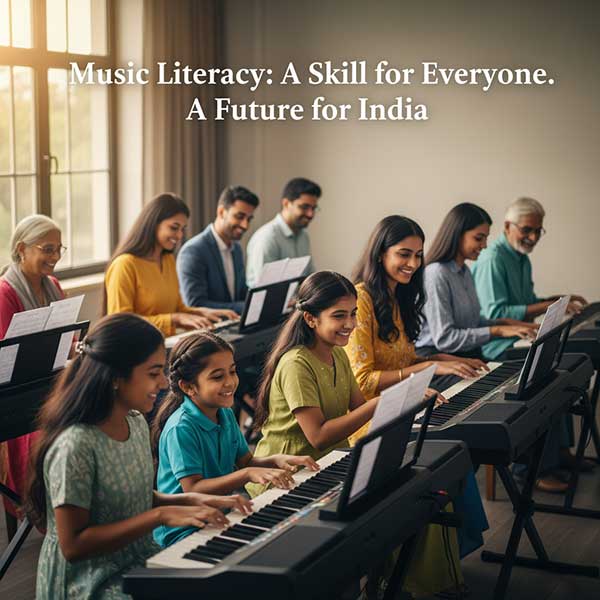
MUSIC - A Skill for Everyone