Future Ready Schools: Making Music a Core Interdisciplinary Subject for Every Child

How integrating structured music learning across the curriculum builds smarter, emotionally stronger, and future-ready students

India’s Youth and the Power of Education

India’s Youth and the Power of Education

India, with one of the youngest populations in the world, stands at the threshold of unprecedented growth and development. Each child and young person represents not only a future worker, but a future creator, innovator, problem solver, and nation builder. To unlock the vast potential of this young demographic, the country needs to provide exceptional education that nurtures not just academic excellence but creativity, problem-solving, emotional balance, and social skills.

The current educational focus on mathematics, science, and linguistics has undeniably shaped the modern world. These disciplines have enabled India to become a global hub for engineering, information technology, and research. Today, we are in an era in which computer science, artificial intelligence, data science, and robotics dominate educational discourse and policy conversations. Governments, institutions, and corporations are investing billions in improving the cognitive potential of machines through algorithms and automation.

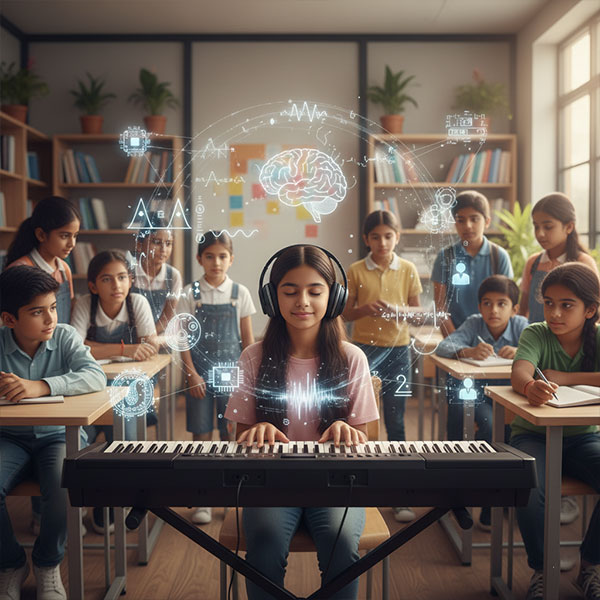
However, in this intense focus on machine intelligence, we may be in danger of neglecting the most powerful, accessible, and human tool for enhancing brain function and lifelong learning: music. Research using advanced brain imaging techniques such as functional near-infrared spectroscopy (fNIRS) shows that listening to music, playing an instrument, and singing activate widespread brain networks that support attention, memory, motor coordination, and emotion. Music not only entertains, but it also shapes the brain.

Studies on music and the brain show that musical training strengthens neural pathways, improves executive function, and supports emotional regulation. Music engagement is associated with better academic performance, healthier social interaction, and improved mental health across age groups, from children in school to older adults. In other words, if India wants to turn its demographic advantage into a true development advantage, it must invest not only in coding labs and robots, but in music rooms and music literacy for every child.
Why Music Education

Why Music?

Music, as an interdisciplinary subject, offers unparalleled benefits for cognitive, emotional, and social development. Neuroscientific research reveals that music has a profound effect on the brain’s structural and functional anatomy, influencing areas such as memory, attention, language acquisition, emotional regulation, and even physiological health. Studies that examine brain activity during music engagement report enhanced lateralisation of brain activation, stronger connectivity between regions, and increased neuroplasticity. Music literally reorganises and strengthens the brain.

The fNIRS scoping review by Ding, Li, and colleagues shows that listening to music, playing instruments, and singing support cognitive, emotional, and motor skills. The review highlights that musicians and trained learners display distinct neural responses compared to non-musicians, with more efficient processing and greater synchronisation across brain regions. These changes are not limited to professional performers. Even structured music learning in childhood can produce lasting benefits for attention, working memory, and problem-solving.

Other work, such as the research summarised by Donald Hodges, demonstrates that musical training is associated with structural brain changes, improved executive functioning, enhanced emotional processing, and better social interaction. Music training supports language development and speech processing because the neural networks used for understanding rhythm, pitch, and timing overlap with those used for understanding speech and reading.

Psychological research, including work shared by the American Psychological Association, shows that music is a powerful tool for emotional regulation. It reduces stress and anxiety, supports a positive mood, and builds emotional resilience. Music activates multiple brain regions associated with reward, motivation, and social bonding. This is why shared musical experiences in choirs, ensembles, or classrooms are so powerful for building empathy and community.

As we continue to navigate the complexities of modern life, facing unpredictable changes, digital overload, and growing mental health challenges, music stands not only as a subject of study but also as a potential therapy for all. It can support cognitive rehabilitation after injury, help children with learning difficulties, and provide emotional support in times of crisis.

To better understand the powerful interdisciplinary nature of music and why it deserves a central place in every child’s education, it is helpful to explore its intersection with science, mathematics, technology, history, psychology, culture, and education.

Why We Need Music in Every School

While mathematics, science, and language are essential components of any curriculum, music deserves a central place in every school and university timetable. Historically, music was not treated as a mere extracurricular activity. Up until the Middle Ages, music was one of the four subjects of the quadrivium, along with arithmetic, geometry, and astronomy. It was regarded as a way to understand harmony, proportion, and the deeper order of the universe.

In many ancient civilisations, including in India, music, mathematics, and philosophy were seen as interconnected paths to wisdom. Ragas and talas encoded complex mathematical and emotional structures. Chanting, devotional singing, and traditional instruments were part of education and spiritual practice, not an optional hobby.

Music Education for Schools

In the modern era, music has often been pushed to the margins of the school day, treated as an optional extra that can be sacrificed when there is pressure around board exams or competitive entrance tests. This is a serious loss. Evidence from decades of research shows that regular, high-quality music education is linked with better performance in mathematics and reading, higher motivation, improved discipline, stronger social skills, and better mental health. Meta-analyses that review fifty years of research on music and mathematics consistently find that students who participate in music learning show higher math scores and stronger spatial-temporal reasoning.

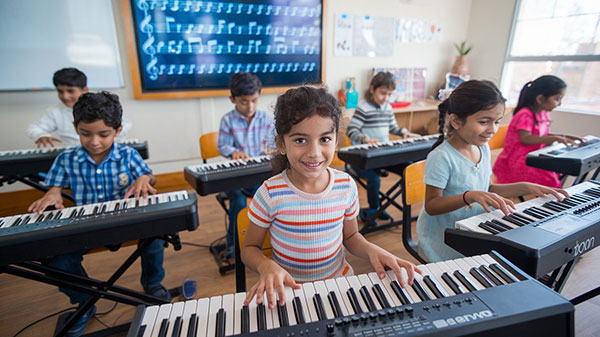
If India wants to prepare young people for a world that demands creativity, emotional intelligence, collaboration, and lifelong learning, then music must return to its rightful place as a core subject. Every child, regardless of background, deserves access to structured music literacy, not only as preparation for performing arts careers, but as an investment in whole brain development and human potential.

Music as an interdisciplinary subject

Music as an Interdisciplinary Subject

Music as an Interdisciplinary Subject

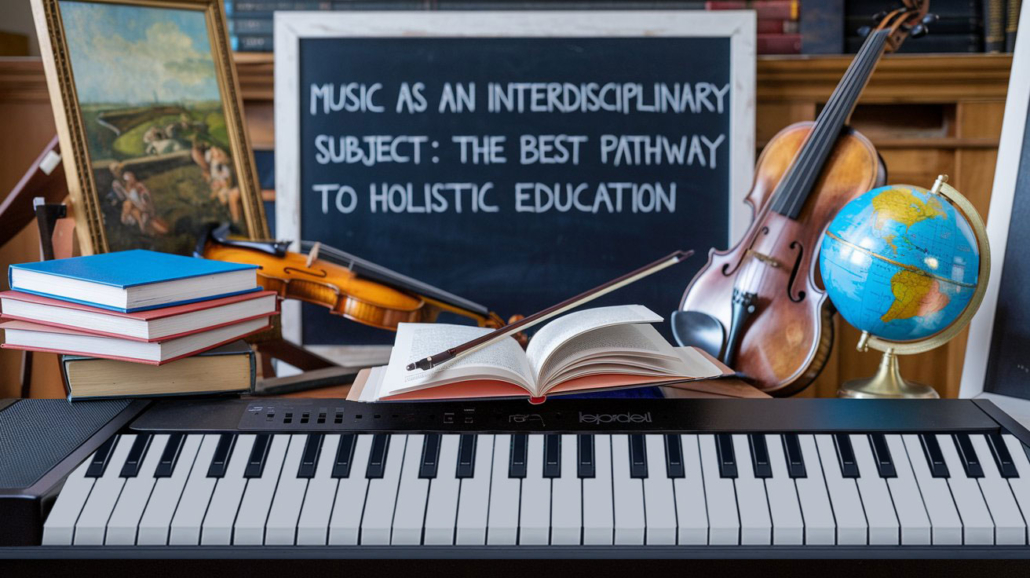
Music, inherently connected to a wide range of fields, is not only an art form but also a powerful interdisciplinary subject that intersects with multiple domains such as science, mathematics, technology, history, psychology, culture, and language. Its interdisciplinary nature allows for a deeper exploration of human expression, cognition, and societal development.

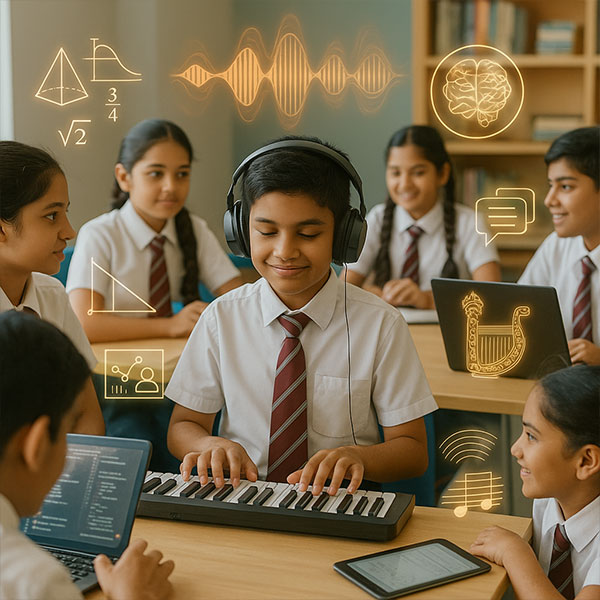
When a learner studies music, that learner is not only learning to sing or play correctly in tune. The learner is engaging with acoustic science through pitch and resonance, using fractions and ratios through rhythm, applying technology through recording and editing, and understanding history and culture through genres and traditions. Music becomes a living laboratory in which students can see how different disciplines connect in real life.

For educators, music offers rich opportunities for integrated projects. A single theme, such as a folk song from a region of India, can become a doorway into geography, history, language, cultural studies, and even environmental awareness. This kind of connected learning is exactly what modern education frameworks such as the National Education Policy (NEP 2020) recommend. Music provides one of the most natural and joyful ways to implement such interdisciplinary learning.

1. Music and Science

The connection between music and science is profound, especially in areas like acoustics, sound engineering, and psychoacoustics. The physics of sound waves, resonance, and frequencies helps students understand concepts related to vibrations, pitch, and harmonics. When learners explore how a string vibrates, why a flute sounds different from a drum, or how a microphone captures sound, they are applying scientific thinking in a hands-on way.

Neuroscience adds another powerful layer to this connection. Brain imaging studies show that music engagement leads to increased neuroplasticity, which is the brain’s ability to change and reorganise in response to experience. The Ding et al scoping review on music and brain function using fNIRS technology highlights how music listening, playing, and singing activate networks across both hemispheres of the brain and support more efficient brain organization.

Music is also central to the emerging field of neuromusicology, which studies how rhythm, melody, and harmony influence perception, attention, and emotion. This research has given rise to evidence-based music therapy, used in hospitals and clinics to support patients with stroke, Parkinson’s disease, dementia, autism spectrum conditions, and emotional difficulties. Students who learn music while also learning about the brain can see directly how science translates into healing and human care.

Music and Science

2. Music and Mathematics

Music is intricately linked to mathematical principles. Rhythms are based on fractions, intervals relate to ratios, and musical scales rely on patterns. When a student reads a rhythm that divides a bar into half notes, quarter notes, and eighth notes, that student is practising fractions in motion. When learners understand octave relationships, frequency ratios, and chord structures, they are experiencing number relationships in sound.

Meta-analyses of music and mathematics research, including the review of fifty years of studies on music’s impact on math achievement, consistently show a positive correlation between sustained music education and higher math scores. These benefits appear across age groups and socioeconomic backgrounds. Music training improves spatial-temporal reasoning, which is essential for geometry, physics, and engineering. It strengthens working memory and pattern recognition, both critical for algebra and problem solving.

Research on rhythm-based music training, such as that discussed by Schellenberg and Weiss, suggests that structured rhythmic practice can enhance analytical thinking and overall cognitive abilities. Children who engage in music learning are often better at detecting patterns, switching between tasks, and persisting with challenging problems. Music becomes a practical, enjoyable way to build the same cognitive muscles that are needed for mathematics and scientific reasoning.

Music and Maths

3. Music and Technology

With the rise of digital tools, music has become more accessible and innovative through technology. Today’s learners can compose, record, edit, and share music using laptops, tablets, and smartphones. Music technology courses teach audio engineering, digital music production, sound design, and even coding for interactive music experiences. This merges creativity with technological proficiency and prepares students for careers at the intersection of arts and technology.

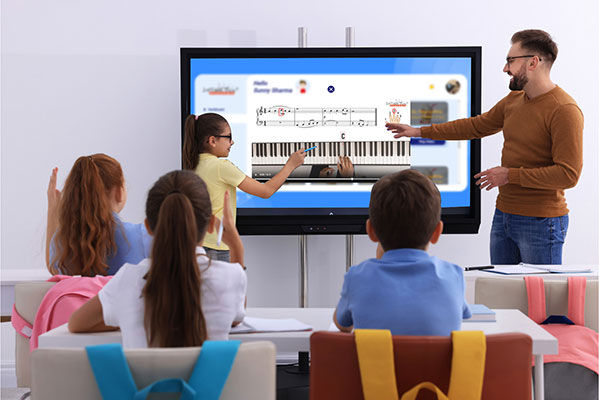
Artificial Intelligence, Machine Learning, and deep learning are transforming the way we create and learn music. AI systems can analyse a learner’s performance, give precise feedback on timing and pitch, and personalise practice routines. They can generate accompaniment tracks, suggest creative variations, and help learners progress at their own pace. At LorraineMusic.ai, we integrate these technologies into our personalised music learning platform so that every child can experience high-quality coaching, even in schools where human music teachers are limited.

Through music technology, students also gain exposure to broader digital skills such as file management, digital collaboration, user interface understanding, and basic programming concepts. They begin to see technology not only as a consumption tool, but as a creative instrument. This shift from passive use to active creation is essential for preparing youth for future digital economies.

Music and Technology

4. Music and History

Music serves as a reflection of cultural and historical contexts. Exploring music as an interdisciplinary subject in relation to history allows students to understand the social, political, and economic forces that shaped various musical movements and genres. From Renaissance polyphony to Baroque compositions, from folk songs to jazz, rock, and hip hop, each genre offers insight into the period in which it was created.

In the Indian context, classical, folk, devotional, and film music trace the journey of civilisation, spirituality, independence movements, and social change. Patriotic songs, bhajans, Sufi music, and protest songs reveal how people responded to colonial rule, social inequality, and aspirations for freedom and justice. When students study history through music, events become human and emotionally relatable, rather than distant and abstract.

This approach encourages critical thinking. Learners can ask why certain voices were amplified and others silenced, how technology such as the gramophone or streaming changed music distribution, and how globalisation has influenced musical identities. Music history therefore, becomes a powerful lens for understanding heritage, power, and change.

5. Music and Psychology

Music has long been studied for its emotional and psychological effects. Music psychology explores how humans perceive, process, and react to music emotionally and cognitively. Research shows that music can reduce stress, enhance mood, and improve memory retention. The American Psychological Association highlights how music supports emotional regulation, helping individuals manage anxiety, sadness, and anger through listening, singing, or playing.

Group music making, such as choir singing or ensemble playing, fosters a sense of belonging and social connection. It builds empathy, as learners learn to listen to one another, blend, and support the collective sound. In classrooms, simple musical activities such as rhythm circles, singing together, or using background music thoughtfully can calm students, increase focus, and create a positive emotional climate for learning.

Music therapy is increasingly recognised in educational institutions and healthcare settings as a legitimate and impactful intervention. For children with special educational needs, including attention difficulties, autism, or learning challenges, music can be a bridge to communication and engagement. For adolescents facing stress and emotional turbulence, music offers a safe space for expression and self-discovery. Integrating music and psychology in education equips teachers to use sound, silence, and rhythm intentionally for wellbeing.

Music and Psychology

6. Music and Culture

Music is an essential part of cultural identity, serving as a medium through which traditions, rituals, and values are passed down. From lullabies sung by grandparents to community festivals, weddings, and religious ceremonies, music carries stories, beliefs, and shared memories. The study of ethnomusicology looks at the relationship between music and culture, focusing on how different communities express their unique identities through musical forms.

For students, exploring music from diverse regions and cultures encourages respect, curiosity, and openness. When a classroom sings songs from different Indian states, or compares folk traditions from India and other countries, learners begin to understand that there are many ways to feel, celebrate, and worship. This reduces prejudice and builds global citizenship.

In a world often divided by language, politics, and belief, music can be a common language that connects people. Teaching music as a cultural bridge helps young people appreciate both their own roots and the rich diversity of the wider world. For a country like India, with its many languages and traditions, music is an ideal tool to nurture unity in diversity.

Music and Culture

7. Music and Language

Learning music and language are deeply interconnected, as both rely on the brain’s ability to process sound patterns, rhythm, and auditory discrimination. Music training enhances phonological awareness, which is the ability to recognise and manipulate sounds. This is a critical skill for language development and early reading. Children who engage in regular musical activities often show better speech perception, clearer pronunciation, and stronger verbal memory.

Research on music and brain function shows that the neural circuits used for processing melody, rhythm, and pitch overlap significantly with those involved in understanding speech, prosody, and syntax. When learners practise listening for subtle differences in notes, they also become better at hearing differences in phonemes, accents, and intonation. This translates into improved reading fluency, vocabulary development, and listening comprehension.

Music can be particularly helpful for children learning additional languages or for those who struggle with reading. Rhythmic exercises, singing in different languages, and call and response activities can joyfully support language acquisition. By engaging shared neural pathways, music training strengthens auditory skills and helps individuals express themselves with greater confidence and clarity.

Music and Language

Conclusion

The interdisciplinary nature of music makes it a powerful subject that cuts across different fields of study, offering students an opportunity to develop holistically. Whether in the context of science, technology, mathematics, culture, history, psychology, or language, the study of music deepens our understanding of the world and contributes to multiple aspects of human development.

For India, with its young population and rich musical heritage, music education is not a luxury. It is a strategic investment in cognitive capacity, emotional resilience, social cohesion, and creative confidence. When we put music at the heart of education, we are not only nurturing future artists but strengthening future scientists, engineers, teachers, entrepreneurs, and leaders.

At LorraineMusic.ai, we leverage these interdisciplinary connections to offer an enriched learning experience that combines evidence-based pedagogy with cutting-edge technology. Our vision is that every learner, in every school, can access structured music literacy that supports academic success, emotional well-being, and lifelong joy in music making.

Benefits of Learning Music

Programs and Courses available for all School Students:

Through these programs, we aim to support schools that are ready to recognise music as an interdisciplinary subject and a central pillar of 21st century education.